
2021
Embracing Blunders
A timeless neighborhood chess parlor honors the art of playing the game in person
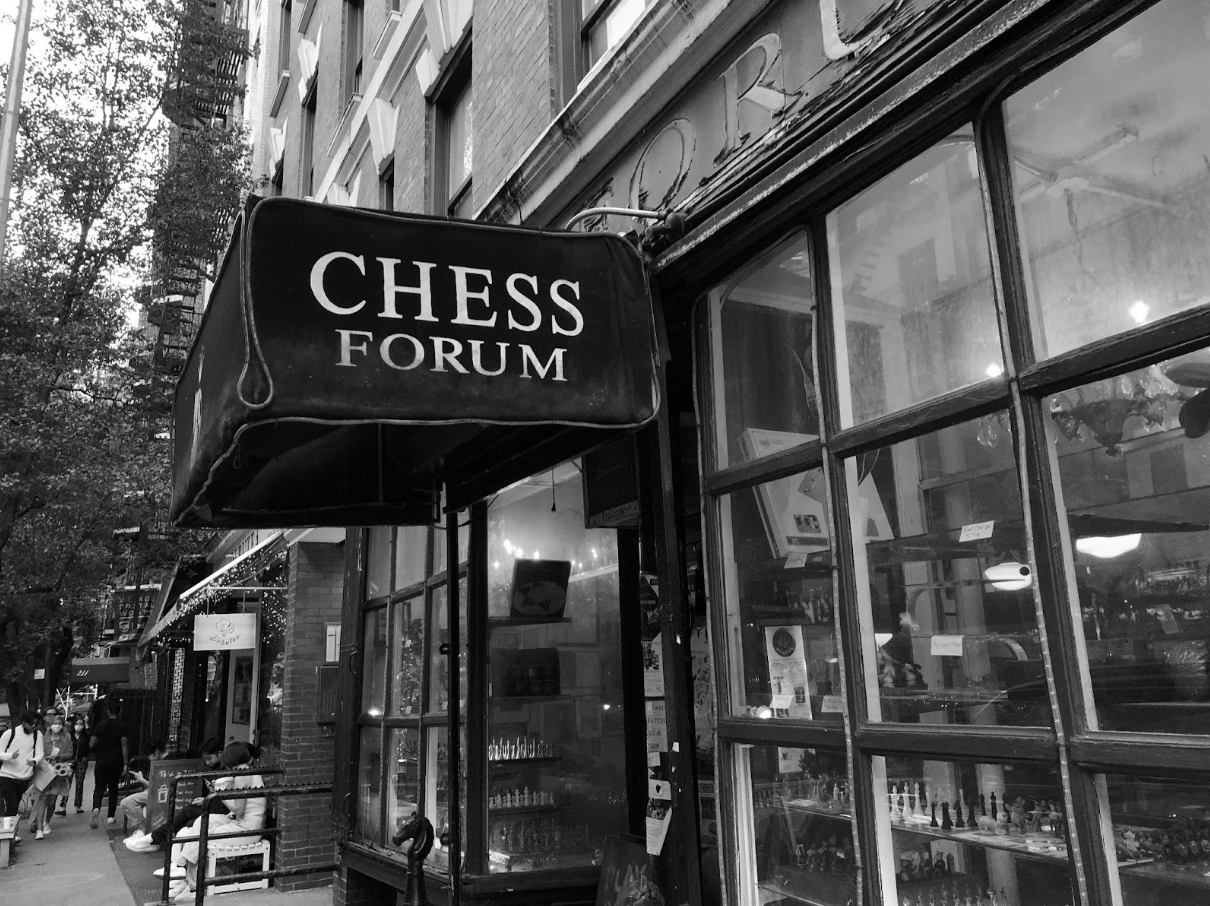
The entrance to Chess Forum on Thompson St. in downtown Manhattan.
“You definitely shouldn’t do that.” I have my hand on my bishop, which I’m attempting to move diagonally to the right. “You’ll lose if you do.”
It’s a quiet Sunday night at Chess Forum, a closet-sized chess parlor just south of Washington Square Park. I’m playing a game with Dudley, who I met five minutes earlier. He’s exact, calculated, competitive, and already has no problem speaking up when I’m about to embarrass myself. A lifelong violinist, Dudley has been playing chess for 8 months, inspired to pick up the hobby during the pandemic’s empty days. He’s not the only one.
Chess Forum has been a cozy community staple since 1975, when it was opened by chess Grandmaster Nicolas Rossolimo, under the name “Rossolimo’s Chess Studio”. Famous locals (including Bob Dylan) were frequent regulars in the early years. Current owner Imad Khachan took over in 1995, after immigrating to New York from Lebanon. He can be found at Chess Forum every day until midnight or beyond, if games are still going on. He will never force the end of a chess game by closing the shop. Instead, he lets them wrap up naturally, often offering tips to the players.
The space looks as though it’s been untouched for decades. Old photographs and paintings crowd the walls, lit by warm lamps of all sizes and styles. In the front room, chess sets for sale are lined up: from dirt cheap to priceless, made of wood, plastic, metal, even crystal. One special set is out on the counter: a chess board designed for three people. The label reads: The Most Dangerous Game.
The shop extends towards the back in a long, narrow room lined with old wooden chairs and tables, all topped with chess sets, waiting to be touched. Chess Forum’s rate is $5 an hour, although they also offer lessons and beverages like tea or hot chocolate.
In a Washington Square News article by Ana Cubas, owner Imad claims that the invention of the internet, has minimized his visitors. In the 90’s, Chess Forum was significantly more crowded throughout the night, as participating in chess required the physical gathering of players. Now, sites like Chess.com make isolated playing possible, as one can play against people around the world on their iPhones, or even compete with computers set at various skill sets.
Computers haven’t always been chess savvy. The ancient game was strictly human until the chess world met a turning point in 1997, when Russian chess grandmaster Garry Kasparov was beat in a series of matches by an IBM supercomputer named Deep Blue. This was the first incident of a computer system defeating a world champion under standard chess tournament time controls. Though the system had gone up against Kasparov several times in previous years, this rematch was its first win. Since then, chess-playing AI systems have only become more and more advanced and widespread. Some praise their omnipresence, allowing instant, private practice for learning players. Others stress the important social aspect of chess: the idea of sitting across from another human being.
In the 1925 chess instructional book My System, by Danish expert Aron Nimzowitsch, he touches on the human urge to mathematize chess in order to master it. However, Nimzowitsch explains that one’s temperament plays a significant role in the game. In tournaments, if a player is nervous, that will manifest itself in their moves. “[Chess is] a game whose complexity is as disturbing as it is attractive. This explains why the chess world has always had great masters whose ambition it was to analyze the game systematically, to reduce it to a series of generalized, reproducible elements, to isolate and enumerate its basic, inter-related propositions. These attempts have never been wholly successful, for in chess, as in all activities of living beings, there is always some residue which eludes definition and analysis” (page xviii). That “residue”, whether it be a risk-taking personality, an elevated heart rate, an impatient edge brought on by missing a meal, adds to the game in a profound way. To Nimzowitsch, that element of humanity is the crucial beauty of chess.
After Dudley beats me twice in under ten minutes, a group of college-age boys gather around the tables. As two start a game, their friend Sean tells me they have been playing since December. “We come here once a week at the very least, and stay until closing,” he says. “Imad is like a parent to us. Showing up here feels like hanging out in his living room.” Imad hovers nearby, chatting personably at length with other regulars. I ask Sean what he likes so much about the game. “There’s always more to learn, there’s always room to be surprised,” he tells me, “when people think chess is boring, they just don’t know enough about it.”
Another player, Olive, talks about why she thinks playing chess in person is so significant: “Chess is about presence and focus. If you make a bad move, it’s nothing but a lack of presence.” She goes on to explain that it’s a sort of meditation. A chess game is about sharing that moment with another person, and embracing any arising feelings. The conversation, connection and emotions all show up on the board.
As midnight approaches, even more players show up, greeting Imad and finding a table or simply observing the others. As a witness of the scene, it’s hard to deny the significance of physically gathering in space. The air is filled with warm chatter mixed with focused silence and classical music leaking out of an old radio. These people all know that simply showing up for a game of chess is a timeless, radical act in an increasingly computerized world.